
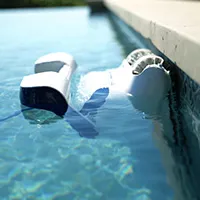
 Help me choose

The one I would buy
I am not going to dress this up as five equally good choices. ICO is the only monitor here I recommend without a paragraph of excuses.
The clear winner
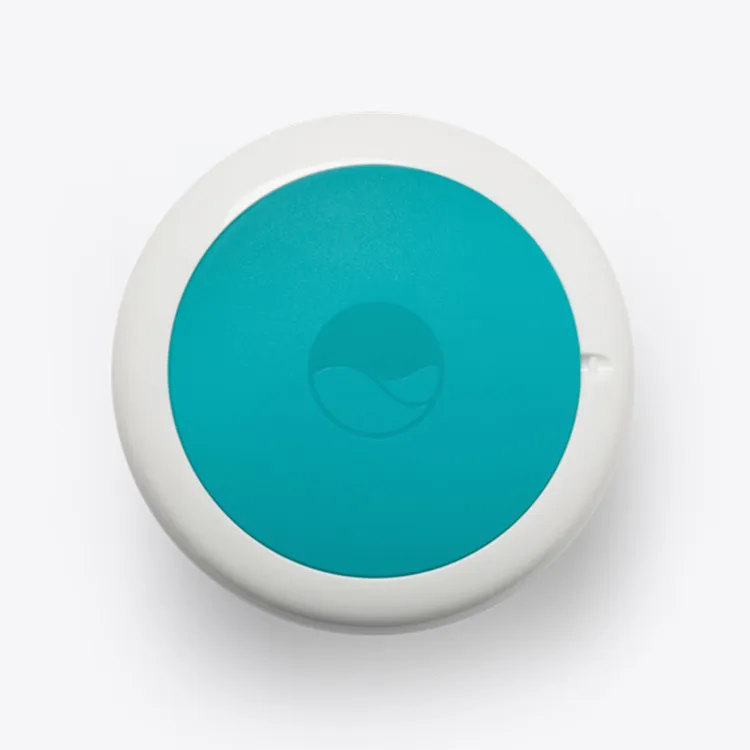
ICO Pool
Buy this one. It gives you useful hourly trends, asks for very little attention, and has the only repair path in this group that feels designed for an owner instead of a support ticket.
- Direct Wi-Fi and 6+ months per charge
- No subscription or test cassettes
- Separate, owner-replaceable probes
- Does not directly test free chlorine
- Costs more up front than iopool and Aiper
Pool water monitor comparison chart
The alternatives each win a narrow specification, then give it back through cassettes, subscriptions, gateways, short battery life, or a murky replacement-parts plan.
| What matters |
ICO Pool
|
 WaterGuru S3 |
 Crystal |
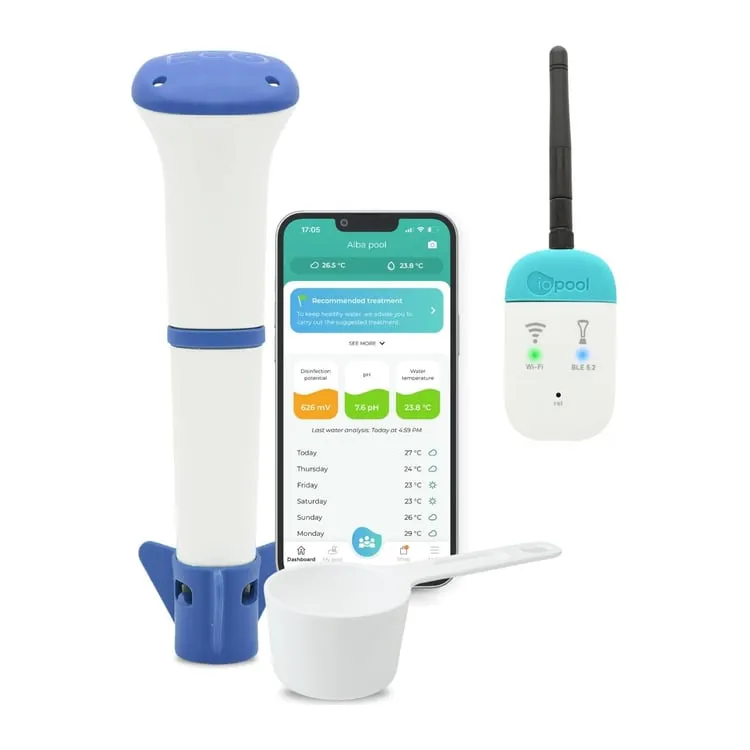 iopool EcO |
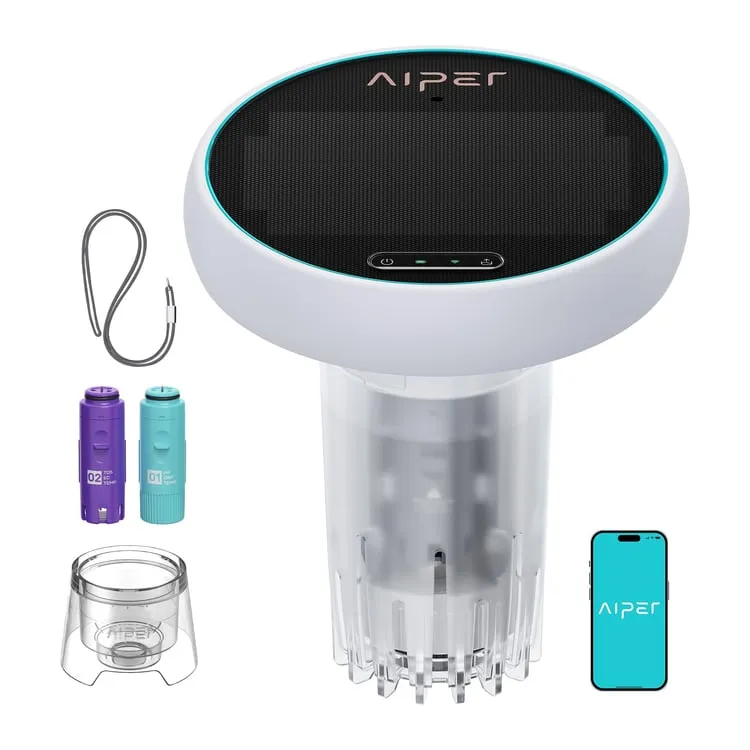 Aiper HydroSync |
|---|---|---|---|---|---|
| Bottom line | Buy itEdge | An expensive once-a-day test kit | Useful features behind a yearly toll | Cheap until the gateway becomes your problem | A great spec sheet buried in footnotes |
| Starting price | $449 chlorine/bromine · $499 salt | $399 with one cassette | From $449 | $359 start · $409 saltEdge | $359.99–$399.99 |
| Automatic readings | Every hour · 24/day | Once daily | Every 10 minutes · 144/dayEdge | Every 15 minutes with gateway | Every hour |
| What it measures | pH, ORP, temperature · salt/TDS on ICO Salt | Free chlorine, pH, alkalinity, CYA, hardness | pH, ORP, temperature | pH, ORP, temperature | pH, ORP, temperature, conductivity, TDS |
| Required recurring cost | $49 seasonal calibration · no app fee or cassettes | C5+ cassettes · about $289/year | $99/year after year one | No subscription · eventual kits | No subscription · support-only probes |
| Remote connection | Direct Wi-Fi + Bluetooth | Direct Wi-Fi | Direct Wi-Fi | Bluetooth + powered gateway | Direct Wi-Fi + Bluetooth |
| Battery and power | USB rechargeable · 6+ months | Solar + USB-C backup | Three disposable AA batteries | 2–3-year battery + powered gateway | Solar assisted · 15-day manual rating |
| Measures salt | Yes · ICO Salt | No | No | No · Salt model is compatibility only | Conductivity and TDS |
| Calibration | Once a season or every 6 months | None · replace cassette | None scheduled · replace whole sensor | Yearly after season one | Every 60 days |
| Repair path | Separate $149 probes with public pricesEdge | No user-replaceable electronics verified | Complete sensor through support | Combined kits · stock varies | Support ticket · no public probe price |
| The annoyance you inherit | Higher upfront price | Buying test pads indefinitely | Paying to keep the useful app | Placing and powering a gateway | Frequent charging, calibration, and vague parts |
The short version is simple: buy ICO. Every competing monitor finds a different way to turn a lower price or flashy specification into more cost, more hardware, or more maintenance after checkout.
If you choose anything else, know exactly which flaw you are volunteering to own. WaterGuru sells you test pads forever. Crystal charges a yearly fee to keep the features that make it smart. iopool adds a powered gateway. Aiper wraps an excellent sensor list in a maintenance schedule I would not tolerate.
How I judged them
I've used all five in real pools, and I am not splitting hairs to hand out participation trophies. A monitor either makes pool care easier over several seasons or it becomes another needy gadget.
- Useful monitoring: A continuous trend beats one daily snapshot for routine ownership.
- Full cost: The checkout price means very little once cassettes, app fees, batteries, calibration, and probes start piling up.
- Setup friction: A separate gateway and outlet are extra failure points, not features.
- Maintenance: Charging every couple of weeks or calibrating every 60 days defeats the point of automation.
- Repairability: "Contact support for price and availability" is not a serious parts strategy.
I did not invent an accuracy score from marketing claims. Sensors drift and water conditions vary. Whichever monitor you buy, keep a reliable drop kit for occasional confirmation.
Why ICO wins
ICO is the only option here that feels designed around years of ownership instead of a clever launch pitch. It reads pH, ORP, and temperature every hour; ICO Salt adds salt and TDS. The full app stays free, the monitor connects directly to Wi-Fi, and the rechargeable battery runs six months or more.
The biggest win is repairability. Each pH, ORP, and TDS probe is a separate $149 part with a public price. When one ages, I replace one probe. I do not throw out a combined sensor, wait for support to reveal a price, or keep paying a service plan for replacement coverage.
ICO is not perfect. It needs seasonal calibration, costs more up front, and does not directly test free chlorine. Unless that direct chlorine result is non-negotiable, none of those drawbacks comes close to the baggage attached to the alternatives.
WaterGuru SENSE S3
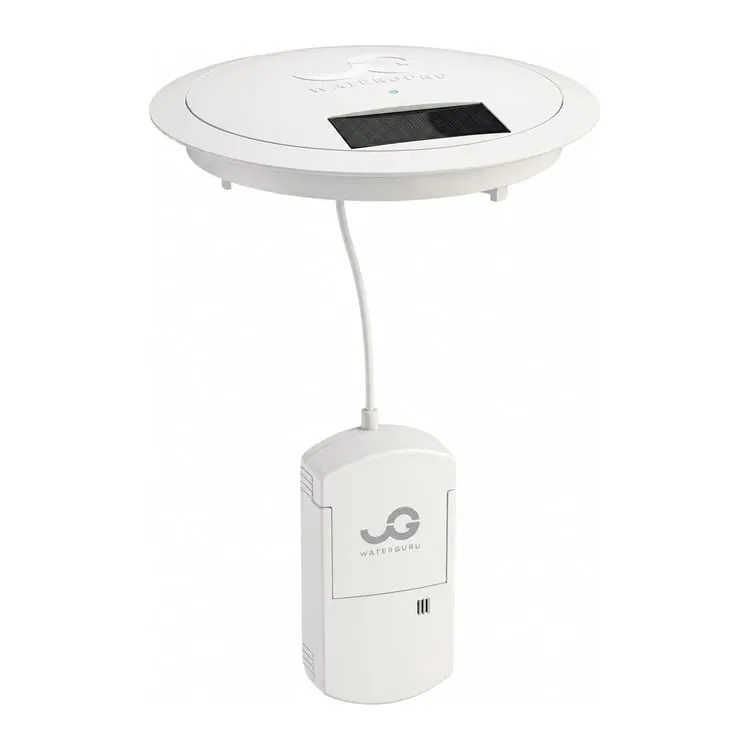
WaterGuru's direct free-chlorine result is useful. Its C5+ cassette also reports pH, alkalinity, cyanuric acid, and calcium hardness. That is the entire case for buying it.
The $399 sticker price is bait if you ignore the cassettes. One C5+ test per day works out to roughly $289 a year at current pricing, and every extra test burns another pad. You are buying an automated once-a-day test kit, not continuous monitoring. Trying to save $50 over ICO at checkout only to keep buying cartridges is hard to defend.
Buy WaterGuru only if a direct daily free-chlorine number matters more to you than hourly trends and recurring cost. For most owners, it is the wrong trade.
Read the full ICO vs WaterGuru comparison →
Crystal Water Monitor
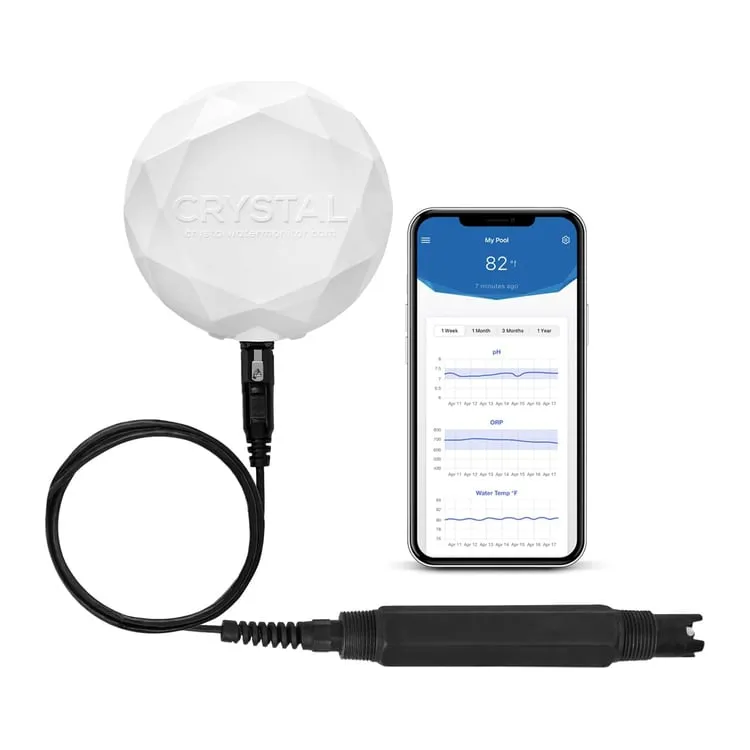
Crystal's 10-minute readings are excellent. Then it asks for $99 every year after year one to keep alerts, charts, dosing advice, priority support, and replacement coverage—the features that justify buying a smart monitor in the first place.
After paying at least $449, putting the useful app behind an annual toll feels backwards. Add three disposable AA batteries and a four-foot cable hanging from a deck-mounted head, and the faster reading schedule stops looking like much of a victory.
Read the full ICO vs Crystal comparison →
iopool EcO
iopool saves about $90 up front and can report every 15 minutes. In exchange, remote monitoring needs a powered cOnnect gateway placed within Bluetooth range of the probe and Wi-Fi range of your router.
That is false economy unless your yard happens to make gateway placement effortless. The "Salt" version does not even measure salt—it is merely compatible with a saltwater pool. Saving a little money to add another box, outlet, and wireless hop is not a deal I would take.
Read the full ICO vs iopool comparison →
Aiper HydroSync
Aiper HydroSync is the spec-sheet trap of this group. Hourly pH, ORP, temperature, conductivity, and TDS at a lower price sounds fantastic.
Then the manual lists a 15-day battery rating, calibration every 60 days, and roughly one year of probe life. Replacement probes require a support ticket with no verified public price, while the U.S. warranty excludes the water-analyzer and communication kits. Add overlapping HydroComm, HydroSync, Pro, and Pure names, and there are simply too many footnotes for me to recommend it.
Read the full ICO vs Aiper comparison →
Models to avoid
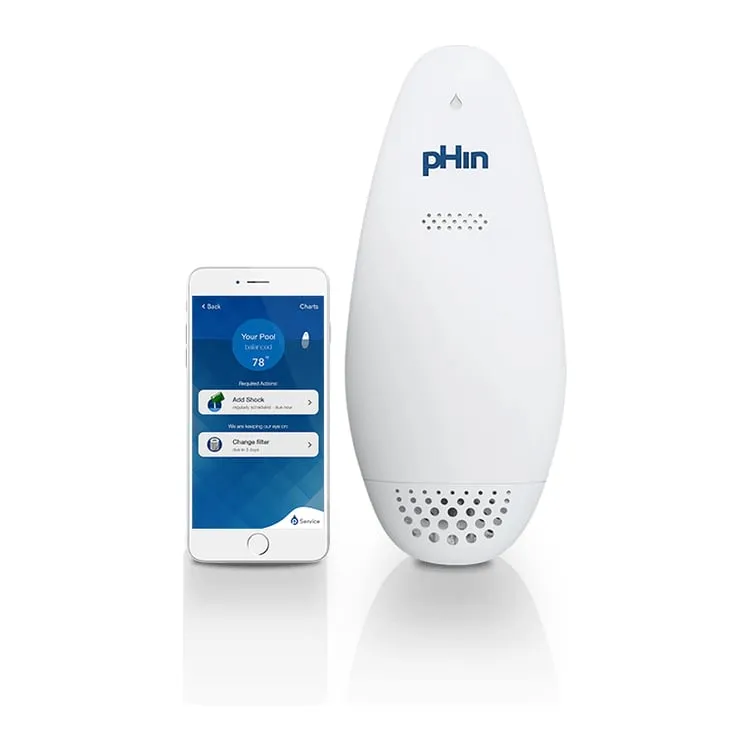
Sutro and pHin are not budget alternatives. They are dead cloud hardware.
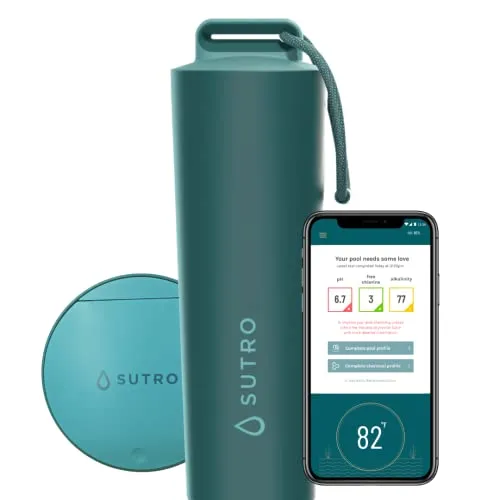
- Sutro: its app and cloud service ended October 31, 2025. Old stock cannot provide readings.
- pHin: Hayward ended service December 20, 2021. The monitor has been offline since then.
Do not let a sealed box or a low marketplace price fool you. A cloud-dependent monitor without its service is e-waste with a logo.
Buying checklist
Before buying anything other than ICO, make sure the narrow feature you want is worth the compromise you are accepting:
- Measurements: Salt-compatible does not mean it measures salt. ORP is sanitizer effectiveness, not a direct free-chlorine result.
- True annual cost: Add cassettes, app tolls, calibration, batteries, and likely probe replacement. Ignoring them makes a cheap monitor look cheaper than it is.
- Signal at water level: Test 2.4 GHz Wi-Fi where the monitor or gateway will actually sit.
- Parts: Look for a price and a purchase link, not just a promise that support can help.
- Backup testing: Keep a quality drop kit for confirmation and for alkalinity, hardness, and stabilizer values your monitor may not track.
Common questions
What is the best pool water monitor?
ICO Pool. It is the only option here that combines hourly readings, no subscription or test cassettes, direct Wi-Fi, long battery life, and individually replaceable probes without a major ownership headache.
What is the best monitor for a saltwater pool?
ICO Salt. It measures salt and TDS rather than merely carrying a "Salt" label. Aiper's documented models also report conductivity and TDS, but the battery, calibration, warranty, and parts caveats make ICO the obvious buy.
Which pool monitors have no subscription?
ICO, iopool EcO, and Aiper HydroSync advertise no required subscription. That does not make them equally good: iopool needs a gateway, and Aiper's maintenance burden is difficult to justify. WaterGuru replaces a subscription with cassettes; Crystal charges $99 a year after year one.
Can a smart monitor replace a manual test kit?
No. A smart monitor is excellent for trends and early alerts, but I still use a reliable manual kit to confirm unusual readings and check values the monitor does not measure.
Are pool water monitors worth it?
They are worth it if consistency is your problem. A monitor will not add chemicals for you, but it can catch a slow drift before it becomes algae, scale, corrosion, or an expensive cleanup.
More ICO comparisons
ICO vs WaterGuru S3
Hourly, cartridge-free monitoring versus one cassette test per day.
ICO vs iopool EcO
Direct Wi-Fi and salt measurement versus a lower-priced Bluetooth probe and gateway.
ICO vs Aiper HydroSync
A broad five-value sensor versus six-month battery life and a clear repair path.
ICO vs Crystal
The same starting price, but Crystal adds a yearly plan and a deck-mounted cable.
Discontinued
ICO vs Sutro
Sutro service ended in 2025. This is a replacement guide, not a close matchup.
Discontinued
ICO vs pHin
pHin service ended in 2021. ICO is a current replacement with serviceable sensors.