
 Help me choose
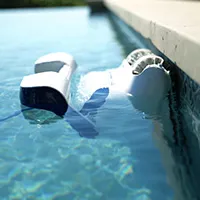
A lazy river breaks every assumption a robotic cleaner is built on. It is a loop, not a basin. It is narrow. Water moves through it. And it is long: even a modest backyard river can run past 100 ft of channel. Anyone searching for the best robotic pool cleaner for lazy rivers deserves to hear that first.
What we can offer is a working method for a small residential river and the three robots that suit it best. The method: current off, one section at a time, and the power supply moved between sections so the cable never has to go around the island. If your river belongs to a resort, a community or a water park, skip to the commercial section and call us.
The Three Closest Fits for a Backyard Lazy River
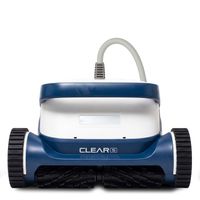
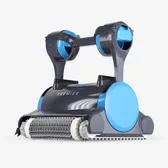
The 59 ft anti-tangle cable is the spec that counts: it is the longest of the three, so each power supply position covers a little more channel and you move it fewer times. The Clear S also suits a stop-and-start routine. Fast mode runs 1 hour, Floor only skips the walls, and manual joystick driving in the Clear app lets you steer the robot out of a bend or back to a spot it missed. A gyroscope and accelerometer help it hold a line down a narrow run.
The catch: its published working depth starts at 2.5 ft, and plenty of backyard rivers sit close to that. Measure the shallowest point before you order.
Best for
Backyard rivers at least 2.5 ft deep throughout, cleaned in sections by an owner comfortable using an app.
Keep in mind
Not designed for a loop, and no robot here is. Confirm depth and channel width first, and never run it with the current on.

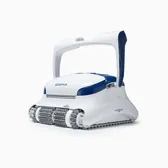
The oversized leaf bag earns the Premier second place. Lazy rivers are usually planted on both banks and on the island, so the channel collects leaves along its whole length, and one section's worth can fill a fine filter early. The Multi-Media system includes the leaf bag, standard fine filters and NanoFilters, swapped in seconds between sections. The 55 ft cable has a 360-degree anti-tangle swivel, and dual ProLine motors move 4,500 GPH.
The catch: the cycle is 3 hours and there is no app, so you end a section by stopping the robot at the power supply. The weekly timer is little use when the power supply keeps moving.
Best for
Landscaped backyard rivers where leaves, not dust, are the main load, and owners who prefer buttons to apps.
Keep in mind
A 3-hour cycle is more than one section needs, and at 20.3 lb it is lifted out and carried every time.
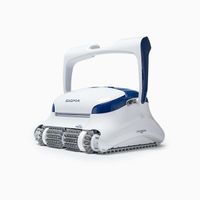
A gyroscope inside SmartNav 3.0 earns the Sigma its place: in a channel with curved walls on both sides, a robot that knows its heading wastes fewer passes bouncing between them. Its four scrubbing brushes and three ProLine motors, 4,500 GPH in all, clean floor, walls and waterline, and the 55 ft cable carries a 360-degree anti-tangle swivel. The myDolphin Plus app works over Wi-Fi and Bluetooth, and its filter alert tells you when a section's debris has filled the cartridges.
The catch: at 24.6 lb it is the heavier of the two Dolphin picks, and you will lift and carry it several times per cleaning. It is also the highest-priced of the three; check the live price on its card.
Best for
Owners of a wide, smoothly curved backyard channel who want phone control and the most methodical coverage.
Keep in mind
Its day-and-time scheduler assumes a robot that stays put, which a river robot does not. Budget for the carrying.
Free Shipping30-Day Trial: use it in your pool, return it within 30 days of deliveryLow Price GuaranteeAuthorized dealer with the full manufacturer's warrantyInstallment options, when offered, appear at checkout
What Decides Whether a Robot Can Work in Your River
-
The Current Has to Be Off
River pumps push water one way around the loop. A robot is made for still water: in a current it is shoved off its line and the floating cable is carried downstream, where it tangles. Shut the river pump off and let the water settle before the robot goes in.
-
Channel Width and Depth
The robot has to turn around inside the channel. Under about 5 ft of width, turning becomes marginal for any robot here, and tight bends make it worse. Depth counts too: the Clear S publishes a 2.5 ft minimum working depth, and a Dolphin must stay fully submerged, so check the manual against your shallowest stretch.
-
Cable Reach per Section
A 55 to 59 ft cable covers one stretch of a loop, not the loop. The robot cannot travel all the way around, because the cable would wrap the island. So the river is divided into sections, each within easy reach of one power supply position.
-
A Cable That Resists Twisting
A channel keeps the robot turning, and every turn can twist the cable. All three picks address that: the Premier and Sigma with a 360-degree anti-tangle swivel, the Clear S with a cable its maker describes as anti-tangle. A robot without either is the wrong tool for a river.
The Three Closest Fits Compared
| Specification |
Clear S
Top pick
|
Dolphin Premier
Pick 2
|
Dolphin Sigma
Pick 3
|
|---|---|---|---|
| Price today | $1,749 | $1,949 | $2,349 |
| Navigation | Gyroscope and accelerometer | SmartNav 2.0 | SmartNav 3.0 with gyroscope |
| Cable | 59 ft anti-tangle | 55 ft with 360° anti-tangle swivel | 55 ft with 360° anti-tangle swivel |
| Pool length | Up to 50 ft | Up to 50 ft | Up to 50 ft |
| Cleans | Floor, walls and waterline | Floor, walls and waterline | Floor, walls and waterline |
| Cycle time | 1, 2 or 3 hours (six modes) | 3 hours | 2.5 hours |
| Scheduling | Weekly schedules in the Clear app | Weekly timer: every day, every 2 days or every 3 days | Weekly scheduler by day and time |
| Warranty | 3 years (limited) | 3 years | 3 years |
| Buy | See priceDetails | See priceDetails | See priceDetails |
Specifications are the manufacturers' published figures. Prices are live from our store.
How to Clean a Backyard Lazy River in Sections
The method rests on one rule: the cable never goes around the island. Walk the river and split it into sections the robot can cover from a single power supply position on the outer bank. As an example only, with roughly 12 ft of setback and 3 to 4 ft of depth, a 55 ft cable leaves near 40 ft of travel either way from where it enters the water. Plan sections well inside that, and use the setback figure in your own manual.
- Shut off the river pump and jets, and wait for the water to go still.
- Set the power supply on the outer bank at the middle of the section.
- Lower the robot in at the middle and feed in only the cable it needs.
- When the section is clean, stop the robot, lift it out, let it drain, and carry robot and power supply to the next position.
- Rinse the filter between sections when leaves are heavy.
Measure the Channel Before You Buy
Take three measurements. Width at the narrowest point, which is often under a bridge or beside an entry step, not in the open run. Depth at the shallowest point. And the tightest inside bend, because a robot that can turn in a straight stretch may still jam where the walls close in.
If the narrowest point is under about 5 ft, or the water will not keep the robot fully submerged, a brush and a manual vacuum will serve that stretch better than any robot. Bridges matter as well: you cannot lift a robot out from beneath one, so end a section before each bridge.
Resort Rivers and the Robots We Left Out
A resort, community or water park river runs hundreds of feet and is cleaned on a staff schedule. That is commercial equipment territory, not a job for a backyard robot worked in sections. Ask a Pool Pro what fits before buying anything.
Among the other robots, the Quantum has a 55 ft cable with an anti-tangle swivel and is a fair substitute if budget decides. The Cayman and Escape are the wrong tool: shorter cables with no swivel, built for pools up to 33 ft.
Pool Pro Tips for Lazy River Cleaning
- Pool Pro tip: mark each power supply position on the deck with a paint dot or a paver. The next cleaning then needs no measuring.
- Pool Pro tip: net the surface before the robot goes in. Floating leaves that sink mid-cycle land behind the robot, in the stretch it just finished.
- Keep the cable on the outer-bank side at all times. If it drifts toward the island, stop and reset before it wraps.
- Take the robot out when you finish. A river robot is carried, not parked, and it should never be in the channel when the current comes back on.
Lazy River FAQ
Can a robotic pool cleaner run while the lazy river current is on?
No. The current pushes the robot off course and sweeps the floating cable downstream, where it twists and can wrap the island or snag a fitting. Restart the current only after the robot and its cable are out of the channel.
How many feet of lazy river can one robot clean?
Any length of backyard river, if you work in sections, because the limit is cable reach from each power supply position. In a single placement, a 55 to 59 ft cable covers one stretch of channel. The 50 ft rating describes an ordinary pool's longest run, not a loop.
Is there a best robotic pool cleaner for lazy rivers at a resort or water park?
Not among residential robots. A resort river runs hundreds of feet and carries heavy bather traffic, which calls for commercial cleaning equipment. Tell us the channel length, width and depth, and our team of pool professionals will point you the right way instead of selling you a backyard robot.
Will the cable wrap around the island?
It will if the robot travels far enough around the loop. That is the reason for short sections with the power supply on the outer bank: the robot runs out of cable before it can circle the island. A swivel or anti-tangle cable handles twist from constant turns, but nothing undoes a cable that has gone around a fixed object.
Can one robot clean a lazy river and the main pool it connects to?
Yes, as two separate jobs. Clean the main pool as a normal pool, with the robot matched to its length, then do the river in sections. Do not expect the robot to find its own way from pool to river and back: the cable will not follow.
The Honest Rule for Lazy Rivers
If the river is at a resort, or is longer than you are willing to clean in sections, a residential robot is the wrong purchase. If it is a backyard channel at least 5 ft wide, deep enough to keep the robot submerged, and you accept the routine with the current off, choose the Clear S for reach or the Premier for leaves. Pick the Sigma for gyroscope navigation and phone control.
How we pick and how we earn: Pool Express is an authorized dealer and sells every robot recommended in this guide. Picks are ranked for this pool or problem from each robot's published specifications. Prices shown are pulled live from our store and may change. Last updated November 23, 2026.