
 Help me choose
Not every pool floor is the smooth plane a robot would like. Vinyl bottoms settle or wash out and leave soft hollows. Above-ground pools on a sand base collect footprints and heel divots. Liners wrinkle. Old plaster heaves and gets patched, and a retired drain can leave a raised ring in the middle of the floor. The best robotic pool cleaner for uneven floors has to cross all of that without stalling.
Tracks are the first answer: they ride over unevenness better than wheels, and every Dolphin on this page runs on them. After that it comes down to recovery when the robot is tipped off its line, and to weight on a soft base. The limit, stated plainly: a robot can stall in a deep divot or behind a big wrinkle, and it will not level a floor.
The Uneven-Floor Shortlist, Best Fit First
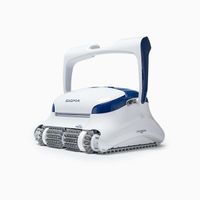
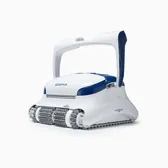
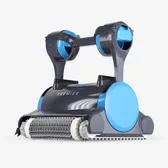
The onboard gyroscope puts the Sigma first: when a heaved patch or a hollow tilts it, SmartNav 3.0 senses the change and the robot re-orients instead of wandering. It rides on HyperGrip tracks, four scrubbing brushes give it more contact on a surface that rises and falls, and three ProLine motors move 4,500 GPH to pull debris out of low spots. Vinyl liner, plaster and gunite are on its published surface list. The catch: it weighs 24.6 lb, more than any other Dolphin here, and it has no above-ground rating, so it answers the uneven in-ground floor only.
Best for
In-ground pools with patched or heaved plaster, a settled vinyl bottom or an old raised drain.
Keep in mind
Highest price on the page. On a soft sand base it is the wrong robot regardless of features.
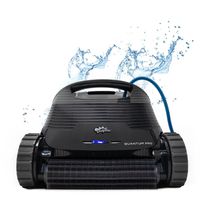
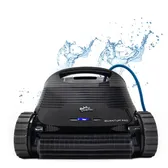
HyperGrip continuous rubber tracks are the case for the Quantum: a continuous track bridges a divot or a ridge instead of dropping into it. SmartNav 2.0 senses ladders and drains, which helps around an old drain ring. At 18.3 lb it is the lightest of the three ProLine Dolphins here, and the lowest-priced of the four 50 ft robots on the page. The catch: scanning navigation instead of a gyroscope, so after a hard tip it recovers by carrying on, and a warranty of 2 years.
Best for
Uneven in-ground floors, vinyl or plaster, where the budget does not stretch to a gyroscope.
Keep in mind
In-ground pools only. A deep divot can still stall it, as it can any robot here.

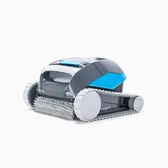
A 14.6 lb robot rated for above-ground pools is what a sand-base floor needs, and that is the Cayman. It is kinder to a soft base than the heavier in-ground robots, it runs on the same HyperGrip tracks, and its HyperBrush turns at double the speed of standard Dolphin brushes. Vinyl liner is on its published surface list, it is rated for pools up to 33 ft, and it also works in-ground, so a small vinyl pool with a washed-out bottom is in range. The catch: floor and walls only, a 50 ft cable with no swivel, and a timer with one setting, every day.
Best for
Above-ground pools on a sand base with footprints and divots, and small in-ground vinyl pools.
Keep in mind
It rides over footprints, but a heel-deep divot or a folded wrinkle can still stop it.
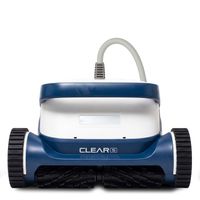
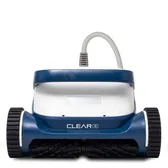
A gyroscope with an accelerometer is the argument for the Clear S: both sensors register a tilt, and coverage tightens once it has run the pool 2 to 3 times. It also moves 8,500+ GPH through two pump motors, the kind of flow that lifts debris out of a hollow, and it scrubs with front and rear active brushes. It ranks fourth because track grip, the feature we lean on most for this job, is what we can point to on the Dolphins. The catch: it needs at least 2.5 ft of water, and its first cycles are its least tidy.
Best for
In-ground pools with gentle unevenness and fine debris settling in the low spots.
Keep in mind
Give it three cycles before judging how it copes with your floor, and check the shallow end depth.

Time is the answer the Premier brings to a lumpy floor: with a 3-hour cycle, a detour around a ridge or a few minutes lost in a hollow costs less of the total. Tracks and 4,500 GPH of flow from two ProLine motors do the crossing, and its Multi-Media filtration suits what uneven floors collect: the leaf bag for debris that pools in low spots, NanoFilters for the silt that settles there. Vinyl liner, plaster, gunite and concrete are on its surface list. The catch: scanning navigation and 20.3 lb, and it is for in-ground pools only.
Best for
Uneven in-ground floors that also collect leaves, where a long timed cycle is welcome.
Keep in mind
It recovers from a tip by carrying on, so let the full cycle run before judging coverage.
Free Shipping30-Day Trial: use it in your pool, return it within 30 days of deliveryLow Price GuaranteeAuthorized dealer with the full manufacturer's warrantyInstallment options, when offered, appear at checkout
How to Judge a Robot on a Floor That Is Not Flat
-
Tracks, Not Wheels
A wheel drops into a dip and has to climb out. A track spans the dip, keeping contact on both sides, and grips a ridge along its length. HyperGrip tracks are fitted to each of the four Dolphins here, and that is the baseline for a floor that is not flat.
-
Recovery After a Tip
A bump or hollow can tilt a robot and swing it off its heading. A gyroscope registers the change and lets the robot re-orient. Scanning navigation recovers too, by carrying on with its pattern, at the cost of some repeated ground.
-
Weight on a Soft Base
Sand under a liner gives way. A lighter robot is kinder to a soft above-ground base, and the Dolphin picks here range from 14.6 lb to 24.6 lb. Only a robot rated for above-ground pools belongs on that kind of floor in the first place.
-
Suction in the Low Spots
Debris collects in hollows the way water collects in a puddle. A robot has to pull it out of a dip its brushes may not fully reach, so flow rate and a clean filter count for more on a lumpy floor than on a level one.
Uneven-Floor Shortlist: Specs Side by Side
| Specification |
Dolphin Sigma
Top pick
|
Dolphin Quantum
Pick 2
|
Dolphin Cayman
Pick 3
|
Clear S
Pick 4
|
Dolphin Premier
Pick 5
|
|---|---|---|---|---|---|
| Price today | $2,349 | $1,599 | $1,049 | $1,749 | $1,949 |
| Cleans | Floor, walls and waterline | Floor, walls, waterline, sun shelves and stairs | Floor and walls | Floor, walls and waterline | Floor, walls and waterline |
| Traction | HyperGrip tracks | HyperGrip tracks | HyperGrip tracks | — | HyperGrip tracks |
| Navigation | SmartNav 3.0 with gyroscope | SmartNav 2.0 | SmartNav 2.0 | Gyroscope and accelerometer | SmartNav 2.0 |
| Working depth | — | — | — | 2.5 to 16.4 ft | — |
| Cable | 55 ft with 360° anti-tangle swivel | 55 ft with anti-tangle swivel | 50 ft | 59 ft anti-tangle | 55 ft with 360° anti-tangle swivel |
| Robot weight | 24.6 lb | 18.3 lb | 14.6 lb | — | 20.3 lb |
| Warranty | 3 years | 2 years | 2 years | 3 years (limited) | 3 years |
| Buy | See priceDetails | See priceDetails | See priceDetails | See priceDetails | See priceDetails |
Specifications are the manufacturers' published figures. Prices are live from our store.
What Kind of Uneven Do You Have?
The fix, and the right robot, depend on what is under the water. Walk the floor, or feel it with a brush, and sort what you find.
- Footprints and heel divots in an above-ground sand base: shallow ones are ridden over, and a lighter robot adds less to the problem.
- Liner wrinkles: small ripples are crossed. A tall, folded wrinkle acts as a wall the robot cannot climb.
- A settled or washed-out vinyl bottom: broad hollows are fine. A sharp-edged hole where the base has washed away needs repair, not a robot.
- Heaved or patched plaster: low ridges are no trouble for tracks. Loose or flaking patches are a repair job, and their debris fills a filter.
- An old drain or fitting standing proud of the floor: a robot may ride up on it and hang. Note where it is and watch the first cycles.
What a Robot Will Not Fix
A robot cleans the floor you have. It will not level it, press out wrinkles or pack down a sand base, and running one more often will not change that. If anything, a problem floor shows itself through the robot: the same stall, in the same place, cycle after cycle.
So fix the big things first. Have large wrinkles reset by a liner professional. Have deep divots and washed-out areas repaired when the pool is next drained. Replace a broken or raised drain cover. Then the robot can do its job. If you are not sure whether your floor is past what a robot can handle, Ask a Pool Pro and describe it to us.
Pool Pro Tips for Uneven Floors
- Pool Pro tip: watch the first two cycles from the deck and note any spot where the robot hesitates or stalls. Those spots tell you what to fix.
- Pool Pro tip: small liner ripples can often be eased toward the wall with a soft brush while the water is warm. Do it before the robot runs.
- If the robot stalls in the same hollow every cycle, move it on and plan the repair. Rescuing it daily for a whole season is not a solution.
Uneven Floors: Your Questions
Will a robot get stuck in a footprint or divot on the pool floor?
Shallow ones, no: tracks span them and the robot carries on. A deep, sharp-sided divot is different, and any robot here can stall in one. If it happens in the same place every cycle, the divot needs filling when the pool is next drained. Until then, expect to move the robot on by hand.
Can a robotic pool cleaner flatten a sand-bottom floor over time?
No. A robot cleans the surface it is given. It is not built to pack sand, and its tracks do not smooth a liner. A light robot simply avoids making things worse. Leveling a sand base means draining the pool and reworking the base, which is a job for the off-season.
What changes for an uneven floor in an above-ground pool?
The shortlist does. An above-ground pool on a soft base needs a robot that is both rated for above-ground use and light, so there the best robotic pool cleaner for uneven floors is the Cayman at 14.6 lb. The Sigma, Quantum, Premier and Clear S are not rated for above-ground pools, however well they handle an uneven in-ground floor.
Is the Dolphin Escape a good option for an uneven above-ground floor?
Yes, and it is a fair alternative to the Cayman. The Dolphin Escape is rated for above-ground pools up to 33 ft, runs on HyperGrip tracks and, at 14.2 lb, is the lightest Dolphin compared here. What keeps it off this shortlist is a shorter 40 ft cable and the lack of a timer as standard. On rounds larger than about 24 ft, measure the cable run before choosing it.
Pool Type First, Repairs Second
Start with the pool type. Above-ground on a soft base: the Cayman, because it is light and rated for it. In-ground: the Sigma if you want a robot that senses a tip and corrects, the Quantum for continuous tracks at a lower price, the Clear S for sensors and flow, the Premier for a long cycle and a leaf bag. Then fix what no robot can: large wrinkles, deep divots, a raised drain. A robot cleans an uneven floor. It does not repair one.
How we pick and how we earn: Pool Express is an authorized dealer and sells every robot recommended in this guide. Picks are ranked for this pool or problem from each robot's published specifications. Prices shown are pulled live from our store and may change. Last updated November 23, 2026.