
 Help me choose
Run a hand along the wall just under the waterline. If it feels slick, that is film, and no amount of suction will remove it until something scrubs it off. This is the case for the best robotic pool cleaner with dual brushes: a brush at each end means the surface is scrubbed on the way out and again on the way back, and more of the robot is in contact with the wall while it climbs.
Our team of pool professionals shortlists four robots with two or more brushes. Two popular models are missing on purpose. The Cayman and Escape each carry a single HyperBrush, a good brush but only one of it, so they do not qualify here. Everything below is about brush count, brush speed, and what those do for a pool.
Four Robots With Two or More Brushes
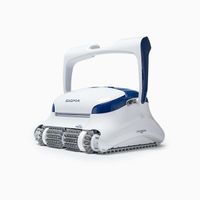
The winning spec is quad scrubbing brushes, double the count on the other picks and the most brush contact in this guide. Four brushes work the floor, walls and waterline through a 2.5-hour cycle, while three commercial-grade ProLine motors move 4,500 GPH to carry off what they loosen. SmartNav 3.0 with an onboard gyroscope helps keep that coverage even from one end of the pool to the other. The catch is price and weight: it is the highest-priced robot on this page and, at 24.6 lb, the heaviest of the Dolphins here to lift out.
Best for
Textured plaster or pebble pools up to 50 ft, and owners fighting film that keeps returning to the walls.
Keep in mind
Top of the price range and 24.6 lb. If two brushes are enough, the next pick costs less.

The spec that qualifies it is the plain one: dual scrubbing brushes, working floor, walls and waterline for a full 3-hour cycle. They are backed by dual commercial-grade ProLine motors at 4,500 GPH, the same flow as the Sigma, and by Multi-Media filtration, so what the brushes lift can be caught on NanoFilters, standard fine filters or the oversized leaf bag as the pool requires. A 3-year warranty matches the Sigma for less money. The catch: these are scrubbing brushes, not the double-speed HyperBrush fitted to the Quantum, and every control is on the power supply.
Best for
Owners who want two brushes, strong flow and flexible filtration without paying for phone control.
Keep in mind
Its one cycle length is 3 hours, and it sits in the upper price range. See the live price on the card.
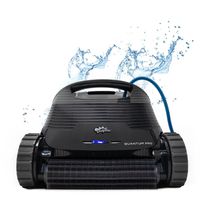
The winning spec is the dual HyperBrush, two brushes that spin at twice the speed of standard brushes. Where the first two picks add brush contact, this one adds brush action: more strokes on each patch of surface in a shorter, 2-hour cycle. It is also the one robot here whose listed coverage includes sun shelves, Baja ledges and stairs, where film builds quickly in warm, shallow water. The XXL MaxBin holds what comes off. The catch: flow is 4,000 GPH against 4,500 on the two Dolphins above, and the warranty is 2 years.
Best for
Pools with ledges, shelves or steps, and buyers who want dual brushes at the lowest price on this page.
Keep in mind
Lower flow than the Premier and Sigma, and a shorter warranty than the other three picks.
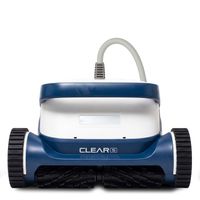
The qualifying spec is front and rear active scrubbing brushes, one at each end, which is the dual-brush layout under another name. Behind them sits the highest flow on this page, 8,500+ GPH from two pump motors, plus two drive motors and a gyroscope and accelerometer guiding coverage of floor, walls and waterline. A Waterline only mode puts both brushes on the scum line and nothing else. It ranks fourth on a tie-break, not a fault: two brushes against the Sigma's four, and no published brush speed to set against the HyperBrush.
Best for
In-ground pools up to 50 ft where waterline scum is the main complaint and app control is welcome.
Keep in mind
Brush speed is not published. The Clear UV has the same brushes plus a UV-C light, at a higher price.
Free Shipping30-Day Trial: use it in your pool, return it within 30 days of deliveryLow Price GuaranteeAuthorized dealer with the full manufacturer's warrantyInstallment options, when offered, appear at checkout
What Two Brushes Change
-
Scrubbing in Both Directions
A robot crosses the pool, reverses and comes back. With a brush front and rear, the leading edge is always a brush, so dirt is loosened ahead of the intake on both passes. With one brush, it leads in one direction and trails in the other.
-
Wall and Waterline Contact
On a wall, the brushes are where the scrubbing happens and part of how the robot stays planted. Two brushes give more contact across the climb and at the waterline, where sunscreen and body oils leave their band.
-
Count Versus Speed
More brushes and faster brushes are different routes to the same goal. The Sigma adds brushes: four of them. The Quantum speeds them up: its dual HyperBrush turns at twice the speed of standard brushes. The Premier pairs two scrubbing brushes with a 3-hour cycle.
-
What Is Under the Brush
Texture decides how much brushing a pool needs. Smooth vinyl and fiberglass release film easily. Plaster, pebble and tile grout hold it in pits and joints and reward extra brush contact. The rougher the finish, the stronger the case for more brush.
Brush Setups Side by Side
| Specification |
Dolphin Sigma
Top pick
|
Dolphin Premier
Pick 2
|
Dolphin Quantum
Pick 3
|
Clear S
Pick 4
|
|---|---|---|---|---|
| Price today | $2,349 | $1,949 | $1,599 | $1,749 |
| Cleans | Floor, walls and waterline | Floor, walls and waterline | Floor, walls, waterline, sun shelves and stairs | Floor, walls and waterline |
| Scheduling | Weekly scheduler by day and time | Weekly timer: every day, every 2 days or every 3 days | Weekly timer: every day, every 2 days or every 3 days | Weekly schedules in the Clear app |
| App | myDolphin Plus (Wi-Fi and Bluetooth) | No app; controls on the power supply | myDolphin Plus (Wi-Fi) | Clear app (iOS and Android) |
| Filtration | NanoFilters and standard filter cartridges | Multi-Media: NanoFilters, oversized leaf bag and standard fine filters | XXL MaxBin basket with standard and NanoFilter panels | UltraFilter basket: 1-micron fine and 180-micron coarse panels |
| Brushes | Quad scrubbing brushes | Dual scrubbing brushes | Dual HyperBrush | Front and rear active brushes |
| Navigation | SmartNav 3.0 with gyroscope | SmartNav 2.0 | SmartNav 2.0 | Gyroscope and accelerometer |
| Cable | 55 ft with 360° anti-tangle swivel | 55 ft with 360° anti-tangle swivel | 55 ft with anti-tangle swivel | 59 ft anti-tangle |
| Warranty | 3 years | 3 years | 2 years | 3 years (limited) |
| Buy | See priceDetails | See priceDetails | See priceDetails | See priceDetails |
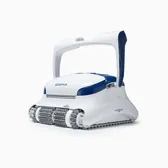
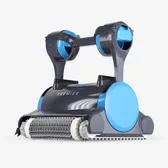
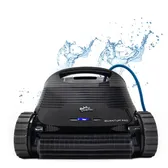
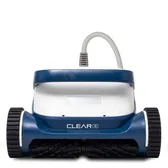
Specifications are the manufacturers' published figures. Prices are live from our store.
What a Brush Does That Suction Cannot
A robot's pump moves water through a filter. Anything loose in that water gets caught. Anything stuck to the pool does not. Algae film, the slippery biofilm that forms on shaded walls, sunscreen residue at the waterline and dirt pressed into plaster all cling to the surface, and flow alone slides past them.
Brushes break that bond. They lift the film into the water in front of the intake, where the filter can finally hold it. That is why brush count belongs next to flow when you compare robots, and why it matters most on the surfaces you touch: the steps you sit on and the walls you push off.
Dual, Quad, HyperBrush, Active: Reading the Labels
Brush names vary by maker, and it is easy to compare the wrong things. Dual means two brushes. Quad means four. HyperBrush is Dolphin's name for a brush driven at twice the speed of its standard brushes. Active, in the Clear specification, describes powered scrubbing brushes front and rear. None of these terms tells you the brush material or how long it lasts, so read them as layout and speed, nothing more. The table lists what each published spec says, including the two single-brush robots left off this page.
| Robot | Published Brush Spec | On This Page? |
|---|---|---|
| Dolphin Sigma | Quad scrubbing brushes | Yes, first |
| Dolphin Premier | Dual scrubbing brushes | Yes, second |
| Dolphin Quantum | Dual HyperBrush, twice the speed of standard brushes | Yes, third |
| Clear S and Clear UV | Front and rear active scrubbing brushes | Clear S, fourth |
| Dolphin Cayman and Escape | One HyperBrush | No: single brush |
Where Dual Brushes Still Fall Short
More brush is not a cure-all, and it is better to hear that before buying. During an algae treatment the pool still needs brushing by hand, because a robot does not reach every corner, the top steps or the space behind a ladder, and live algae has to be treated, not just moved. Brushes do not replace sanitizer.
Brushes are also wear parts. A rough finish wears them faster, and a worn brush loses its bite on walls long before it looks ruined. Inspect them whenever you rinse the filter, and replace them when the surface has gone smooth or the robot starts slipping on climbs.
Pool Pro Tips for Better Scrubbing
- Pool Pro tip: take the robot out before shocking, brush the walls by hand, then send it back in once the water has settled to collect what the brushing loosened.
- Pool Pro tip: check the brush ends for hair and string. A wrapped brush turns slowly or stalls, and the robot loses grip on walls.
- Keep the filter clean on scrubbing days. The film that brushes lift is fine material, and it loads the media quickly.
- On pebble or rough plaster, expect to replace brushes sooner than on vinyl, and budget for it.
Dual Brush Questions
Is a robotic pool cleaner with dual brushes better than a single-brush model?
For walls and textured finishes, yes: two brushes scrub on both the outbound and return pass and put more contact on a wall. A single HyperBrush still scrubs well on floors and smooth surfaces, and the robots that carry one cost less. Buy two brushes for film and texture, not for leaves.
Do the Dolphin Cayman and Escape have dual brushes?
No. Each has one HyperBrush, which spins at twice the speed of standard Dolphin brushes. That is an effective brush, but a single one, so neither qualifies for a dual-brush shortlist. They remain sound choices for smaller pools where floor and wall cleaning is the goal.
Will two brushes scratch a vinyl liner or fiberglass?
The Premier, Sigma and Quantum all list vinyl liner and fiberglass among their published surfaces. The practical risks are grit caught in a worn brush and loose liner wrinkles, so rinse the brushes along with the filter and smooth out wrinkles where you can. For the Clear S, check the manual for its surface list.
Does a quad-brush robot clean twice as well as a dual-brush one?
No, and we would not claim it. Four brushes give more contact per pass, which helps on textured finishes and stubborn film. On a smooth, well-kept pool the difference narrows and two brushes are plenty. Pay for quad when the surface is rough or the film keeps coming back.
Can dual brushes remove algae from pool walls?
They lift the film algae forms so the filter can catch it, which helps keep walls clean between treatments. They do not treat an active bloom. Algae needs correct chemistry and hand brushing of corners and steps first; the robot then collects the dead material, ideally on fine filters.
The Brush Rule
Decide by surface and by symptom. Rough finish, or film that keeps coming back: the Sigma's four brushes. Two brushes, strong flow and a long warranty at a lower price: the Premier. Ledges, steps and a tighter budget: the Quantum's double-speed dual HyperBrush. Waterline scum and a taste for app control: the Clear S. If the pool is small, smooth and mostly needs its floor cleaned, a single-brush robot is honest money saved. Ask a Pool Pro if you are stuck between two.
How we pick and how we earn: Pool Express is an authorized dealer and sells every robot recommended in this guide. Picks are ranked for this pool or problem from each robot's published specifications. Prices shown are pulled live from our store and may change. Last updated November 23, 2026.