
 Help me choose
The best robotic pool cleaner for tight corners is not the one that squeezes furthest in. No robot on this page fits into a 90-degree corner, and none needs to. What cleans a corner is brush contact along both walls and the floor joint, suction close behind the brush, and enough passes that the robot arrives from a different direction each time.
Corners deserve the attention. Circulation is weakest where two walls meet, so fine dirt settles there and algae gets its first foothold. The same is true of the wall-floor joint, step corners and the strip behind a ladder. Our team of pool professionals ranked the Sigma and Premier ahead of the Dolphin Quantum, Clear S and Dolphin Cayman by how much brush each brings to those spots.
Five Robots Ranked for Corner Cleaning
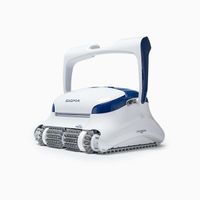
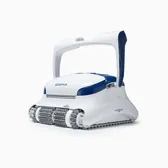
Quad scrubbing brushes are the reason the Sigma leads: four brushes put more bristle on the two walls and the floor joint in a single approach than any other robot in this guide. Three commercial-grade ProLine motors and 4,500 GPH pull what the brushes loosen into the cartridges, and the included NanoFilters hold the fine dust and dead algae that corners collect. The catch: it is the highest-priced pick here, and four brushes still cannot reach the last inch of a true square corner.
Best for
Square-cornered concrete, plaster and tile pools up to 50 ft where corners turn green first.
Keep in mind
Top of the price range on this page; if every corner is coved, a lower-priced pick may be all you need.

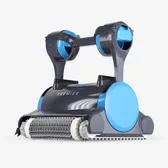
The 3-hour cycle is the Premier's corner-cleaning spec. It is the longest of the Dolphins on this page, and time is what buys repeat approaches from new angles. Dual scrubbing brushes work the joint on each pass, dual ProLine motors move 4,500 GPH, and Multi-Media filtration means NanoFilters for corner silt now and the oversized leaf bag when the corners fill with leaves in the fall. The catch: two brushes, not four, so each individual pass makes less contact than the Sigma's.
Best for
Owners who want thorough corner work from a timer on the power supply, with a 3-year warranty.
Keep in mind
Each cycle runs 3 hours, and it leans on repetition where the Sigma leans on contact.
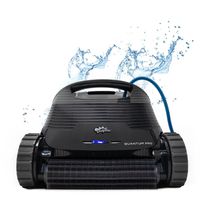
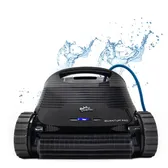
Dual HyperBrush is the spec to notice: two brushes spinning at twice the speed of standard brushes, on a robot whose published coverage includes stairs, sun shelves and Baja ledges. Step corners are some of the tightest in any pool, and the Quantum is the pick here that is built to get up among them. A full set of NanoFilter panels is included, and its price is the lowest of the 50 ft robots in this guide. The catch: a 2-hour cycle and 4,000 GPH give it less time and flow per corner than the two picks above.
Best for
Pools with wide steps, benches or a tanning ledge, where the tightest corners are off the main floor.
Keep in mind
Shorter cycle and a 2-year warranty; heavily soiled corners may need a second run.
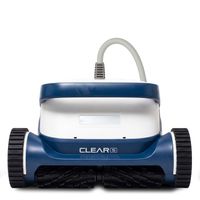
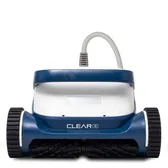
Flow is the Clear S's headline for corners: 8,500+ GPH from two pump motors, the highest in this guide, which helps lift loosened dirt out of the pocket before it resettles. Active scrubbing brushes at the front and rear mean a brush is leading whichever way it travels, and the UltraFilter basket has a 1-micron fine panel for dust. The catch: its working depth starts at 2.5 ft, so the corners of top steps and shallow ledges fall outside its range. That is why the Quantum sits ahead of it here.
Best for
Deep-water corners in in-ground residential pools up to 50 ft, especially with fine dust or dead algae.
Keep in mind
Not the choice for step corners in shallow water, since its published working depth begins at 2.5 ft.

One HyperBrush, spinning at twice the speed of standard Dolphin brushes, is what the Cayman brings to a corner. In a pool of 33 ft or less there is less floor between visits, so each corner is reached again sooner, and over 4,000 GPH from dual 24-volt DC motors carries the loosened dirt into a MaxBin basket with fine panels. The catch: one brush makes the least contact of the five picks, and NanoFilter panels for the finest dust are an optional add-on.
Best for
Vinyl liner and fiberglass pools up to 33 ft with coved corners, in-ground or above-ground.
Keep in mind
Least brush contact of the five and no waterline cleaning, so square corners will see the hand brush more often.
Free Shipping30-Day Trial: use it in your pool, return it within 30 days of deliveryLow Price GuaranteeAuthorized dealer with the full manufacturer's warrantyInstallment options, when offered, appear at checkout
How a Robot Actually Cleans a Corner
-
Brush Contact
Count the brushes. Four scrub more surface per pass than two, and two more than one. Speed counts as well: a HyperBrush spins at twice the rate of a standard Dolphin brush. Contact is what breaks the film in a joint.
-
Approach Angles
A corner comes clean when the robot meets it along the floor, along each wall and on the climb. Longer cycles and orderly navigation produce more of those meetings. A 3-hour cycle has more chances at each corner than a 2-hour one.
-
Suction Behind the Brush
Brushing a corner only relocates the dirt unless water flow carries it into the filter. Flow rate, plus a filter fine enough to hold silt and dead algae, turns a scrubbed corner into a clean one.
-
Corner Geometry
Radius corners, the coved kind common in vinyl liner and fiberglass pools, let a brush stay in contact through the turn. True square corners in tile, concrete and many step designs leave a small pocket no rotating brush reaches.
Brushes, Flow and Cycle Time Compared
| Specification |
Dolphin Sigma
Top pick
|
Dolphin Premier
Pick 2
|
Dolphin Quantum
Pick 3
|
Clear S
Pick 4
|
Dolphin Cayman
Pick 5
|
|---|---|---|---|---|---|
| Price today | $2,349 | $1,949 | $1,599 | $1,749 | $1,049 |
| Cleans | Floor, walls and waterline | Floor, walls and waterline | Floor, walls, waterline, sun shelves and stairs | Floor, walls and waterline | Floor and walls |
| Traction | HyperGrip tracks | HyperGrip tracks | HyperGrip tracks | — | HyperGrip tracks |
| Navigation | SmartNav 3.0 with gyroscope | SmartNav 2.0 | SmartNav 2.0 | Gyroscope and accelerometer | SmartNav 2.0 |
| Working depth | — | — | — | 2.5 to 16.4 ft | — |
| Cable | 55 ft with 360° anti-tangle swivel | 55 ft with 360° anti-tangle swivel | 55 ft with anti-tangle swivel | 59 ft anti-tangle | 50 ft |
| Robot weight | 24.6 lb | 20.3 lb | 18.3 lb | — | 14.6 lb |
| Warranty | 3 years | 3 years | 2 years | 3 years (limited) | 2 years |
| Buy | See priceDetails | See priceDetails | See priceDetails | See priceDetails | See priceDetails |
Specifications are the manufacturers' published figures. Prices are live from our store.
Square Corners vs. Radius Corners
Look straight down at a corner from the deck. If the two walls meet in a visible line, the corner is square. If they blend through a curve, it is a radius corner. The difference decides how much a robot can do.
On a radius corner the brush keeps touching the surface all the way through the turn, and a single fast brush handles it well. On a square corner the robot's body meets one wall before the brush tips reach the point where the walls join, so a small triangle of floor and a narrow strip up the joint stay just out of reach. Tile and concrete pools, and most built-in steps, have corners like this. More brushes shrink that untouched patch; nothing with a rotating brush removes it.
Where the Robot Stops and the Hand Brush Starts
These are the places a robot leaves for you, and none takes more than a minute.
- The last inch of every square corner, floor and wall. A corner brush on the pole reaches it in one stroke.
- The strip between a ladder and the wall. It is narrower than any robot, so brush it or lift the ladder out.
- The inside corners of top steps, where the water is shallow and most robots do not linger.
- Around light niches and return fittings, where the wall is not flat enough for full brush contact.
Why Corners Go Green First
Return jets push water around the pool in a loop, and corners sit outside it. Sanitizer arrives there last, debris settles there first, and a rough or shaded corner gives algae something to hold. A robot helps by scrubbing off the film and filtering out the dirt on every cycle. It does not replace sanitizer, and during an algae treatment the corners still need brushing by hand.
Two robots we sell sit outside this shortlist. The Escape uses the same single HyperBrush as the Cayman and suits the coves of above-ground pools. The Clear UV is the Clear S with a built-in UV-C light controlled from the app, at a higher price, and it cleans corners identically.
Pool Pro Tips for Cleaner Corners
- Pool Pro tip: brush each corner toward the main floor just before you start the cycle. The robot cannot reach the last inch, but it will collect everything you push out of it.
- Pool Pro tip: aim one return jet along the wall toward your dirtiest corner. Better circulation there means less settles between cleanings.
- Fit the finest filter you have when corners hold dust or dead algae.
- Lift removable ladders out for one cycle a month so the robot can scrub the wall and floor behind them.
Corner Cleaning Questions
Can a robotic pool cleaner get all the way into a 90-degree corner?
No. The body stops the robot before the brush tips reach the very point of a square corner. Bristles and suction clean to within about an inch, working from both walls and the floor. That last pocket needs a hand brush now and then, more often in a pool that is prone to algae.
Do more brushes really clean corners better?
More brushes mean more contact per pass, and contact is what loosens the film in a joint. That is why the Sigma's quad brushes lead this page. Speed helps too: the HyperBrush on the Quantum and Cayman spins at twice the standard rate.
Why does dirt keep settling in the same corner of my pool?
Because the water there barely moves. Anything suspended drops out when it drifts into a dead spot, and the same corner is the dead spot every day. A robot removes what has settled. To slow the build-up, re-aim a return jet toward that corner.
Do I need a robotic pool cleaner for tight corners if my corners are rounded?
You need less of one. A coved corner lets the brush stay in contact through the turn, so the Cayman or Quantum is well suited. Pay more for the Sigma or Premier only if the pool also has square step corners or a long wall-floor joint that stays dirty. See the live price on each card.
Our Call on Corners
Buy brush contact first, then time. That makes the Sigma the answer for square corners that turn green, with the Premier close behind for owners who prefer a timer to a phone. Choose the Quantum when the corners that bother you are on steps and ledges, the Clear S for deep corners full of fine dust, and the Cayman for a coved pool of 33 ft or less. Whichever you buy, give each corner thirty seconds with a hand brush before the robot goes in.
How we pick and how we earn: Pool Express is an authorized dealer and sells every robot recommended in this guide. Picks are ranked for this pool or problem from each robot's published specifications. Prices shown are pulled live from our store and may change. Last updated November 23, 2026.