
 Help me choose
For a few weeks each year the pool turns yellow. Pollen lands as a yellow-green film on the surface, where the skimmer has first claim on it. What the skimmer misses becomes waterlogged and sinks, and on the floor it is a fine dust that standard robot filters cannot hold. The robot drives through it, the dust goes in one side and out the other, and the floor looks the same the next morning. The best robotic pool cleaner for pollen fixes that with ultra-fine media and a daily schedule for as long as the trees are shedding.
All five picks below include ultra-fine media in the box. Our Pool Pros also cover the question we hear every spring: whether the yellow on the floor is pollen at all, or the start of mustard algae.
Our Five Picks for Pollen, Ranked
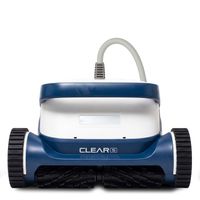
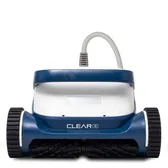
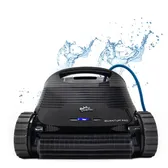
The 1-micron fine panels are the reason the Clear S leads: sunk pollen that slips through a standard panel stays in the UltraFilter basket. The second reason is its Waterline only mode, which sends the robot to scrub the tile band where floating pollen collects and dries, without spending a full cycle on the floor. For the daily runs pollen season calls for, the Clear app holds a weekly schedule; use the 2-hour Regular mode, or Fast for a 1-hour pass on lighter days.
The catch: pollen loads a 1-micron panel quickly, so rinsing after every cycle during the peak is part of the deal.
Best for
Pools up to 50 ft with tile at the waterline, in regions with a heavy spring pollen drop.
Keep in mind
Schedules are set in the app. When catkins fall, switch to the 180-micron coarse panels first.

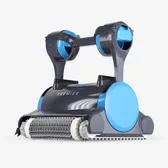
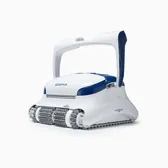
Two included filters decide it for the Premier. NanoFilters take the sunk pollen dust; the oversized leaf bag takes the catkins, tassels and seed husks that oaks and pines throw down in the same weeks. Both are in the box, both load from the top without tools, and the swap takes seconds. Its power-supply timer can be set to daily for the whole season, and each cycle covers floor, walls and the waterline, where the yellow ring forms.
The catch: there is no waterline-only or short mode, so every pass is a full 3 hours.
Best for
Tree-heavy yards where pollen arrives as both dust and strings, and owners who prefer no phone setup.
Keep in mind
Three-hour cycles and no phone alerts. Rinse the NanoFilters after each run while pollen is heavy.
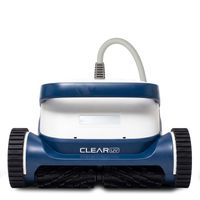
For pollen the Clear UV does everything our first pick does, because it is the same robot underneath: 1-micron fine panels, a Waterline only mode for the yellow ring, front and rear active brushes and weekly schedules in the Clear app. The difference is a UV-C light built in and run from the app, for which you pay more.
The catch: the light is not a pollen feature. Pollen is taken out by the filter and nothing else, so if the yellow dust is your reason for buying, the Clear S gives the same result for less.
Best for
Buyers who have decided on the UV-C model and want the same pollen filtration as the Clear S.
Keep in mind
You pay extra for the light, not for better pollen pickup. Look at both live prices.
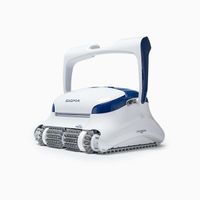
Quad scrubbing brushes put the Sigma on this list. Pollen mixed with sunscreen and oils sticks to tile and to the texture of plaster. Four brushes and three commercial-grade ProLine motors scrub it loose across floor, walls and waterline, and the NanoFilters in the box hold what comes off. In the myDolphin Plus app you can schedule by day and time for the pollen weeks.
The catch: the NanoFilters are cartridges, with no leaf bag or large basket for catkins, so in an oak or pine yard you will be rinsing more.
Best for
Plaster and tile pools where pollen film sticks, and owners who want phone scheduling and filter alerts.
Keep in mind
No bulk collector for catkins, and the highest price on the page.
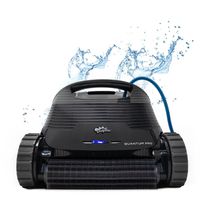
Ultra-fine panels at the lowest 50 ft price on the page: the Quantum ships with a full NanoFilter set, and that is what gets it onto a pollen shortlist. The panels sit in the XXL MaxBin, a basket with more than 400 square inches to spread the load over, so the fine yellow coat does not block it in one pass. Swap to the standard panels and the same big basket handles catkins and tassels. Its 2-hour cycle suits a daily schedule, and it scrubs the waterline, stairs, sun shelves and Baja ledges, the sheltered spots where sunk pollen gathers.
The catch: at 4,000 GPH it moves less water than the other four.
Best for
Budget-conscious owners of pools up to 50 ft, especially with steps or a sun shelf that collects pollen.
Keep in mind
Two-year warranty, against three on the other picks. Rinse the panels every day or two at the peak.
Free Shipping30-Day Trial: use it in your pool, return it within 30 days of deliveryLow Price GuaranteeAuthorized dealer with the full manufacturer's warrantyInstallment options, when offered, appear at checkout
How to Choose for Pollen Season
-
Filtration Fine Enough for Pollen
Sunk pollen is among the finer things a robot is asked to collect. It takes ultra-fine media: NanoFilters or their panel form on the Dolphins, 1-micron panels on the Clear robots. The Cayman and Escape accept NanoFilter panels as an optional add-on; without them they are not pollen robots.
-
Waterline Cleaning
Pollen floats first, and wind pushes it against the tile, where it dries into a yellow ring with sunscreen and body oils. A robot that scrubs the waterline deals with that band on every cycle.
-
Daily Running During the Drop
Trees release pollen for days or weeks on end. A robot that runs every day through that window, on a timer or an app schedule, keeps the dust from building into a layer.
-
Room for Catkins
Oaks, pines and birches drop pollen in strings and tassels as well as dust. Those are a capacity job for a bag or a big basket, and they coat ultra-fine media, so being able to swap filters matters in tree-heavy yards.
Pollen-Season Specs Compared
| Specification |
Clear S
Top pick
|
Dolphin Premier
Pick 2
|
Clear UV
Pick 3
|
Dolphin Sigma
Pick 4
|
Dolphin Quantum
Pick 5
|
|---|---|---|---|---|---|
| Price today | $1,749 | $1,949 | $1,999 | $2,349 | $1,599 |
| Filtration | UltraFilter basket: 1-micron fine and 180-micron coarse panels | Multi-Media: NanoFilters, oversized leaf bag and standard fine filters | UltraFilter basket: 1-micron fine and 180-micron coarse panels | NanoFilters and standard filter cartridges | XXL MaxBin basket with standard and NanoFilter panels |
| Filter access | — | Top-load, no tools | — | Cartridges | Top-load, one-click open |
| Brushes | Front and rear active brushes | Dual scrubbing brushes | Front and rear active brushes | Quad scrubbing brushes | Dual HyperBrush |
| Flow rate | 8,500+ GPH | 4,500 GPH | 8,500+ GPH | 4,500 GPH | 4,000 GPH |
| Cycle time | 1, 2 or 3 hours (six modes) | 3 hours | 1, 2 or 3 hours (six modes) | 2.5 hours | 2 hours |
| Cleans | Floor, walls and waterline | Floor, walls and waterline | Floor, walls and waterline | Floor, walls and waterline | Floor, walls, waterline, sun shelves and stairs |
| Scheduling | Weekly schedules in the Clear app | Weekly timer: every day, every 2 days or every 3 days | Weekly schedules in the Clear app | Weekly scheduler by day and time | Weekly timer: every day, every 2 days or every 3 days |
| Warranty | 3 years (limited) | 3 years | 3 years (limited) | 3 years | 2 years |
| Buy | See priceDetails | See priceDetails | See priceDetails | See priceDetails | See priceDetails |
Specifications are the manufacturers' published figures. Prices are live from our store.
Pollen or Mustard Algae? Check Before You Treat
Yellow dust on the floor in spring is usually pollen. Yellow dust that clings to a shady wall often is not. The two are easy to confuse, and treating one as the other wastes either chemicals or time: pollen needs filtering, while mustard algae needs a chemical treatment that no filter replaces. The quickest check is to look at the patio furniture and the car. If they are yellow too, so is the pool, and for the same reason. Then brush a patch and compare what you see with the table below.
| Sign | Pollen | Mustard Algae |
|---|---|---|
| Where it sits | All over, heaviest downwind and in corners | Shaded walls, steps, behind ladders |
| When brushed | Lifts and drifts away | Lifts, then settles back nearby |
| A day later | Wherever the wind puts it | Back in the same spots |
| On the surface | Yellow-green film | No film |
| What fixes it | Skimming and ultra-fine filtration | Brushing, shock and held chlorine |
The Daily Routine for Pollen Weeks
Pollen season is short, so the routine can be intensive without becoming a burden.
- Run the pump during the day and fit a skimmer sock. Most pollen is caught while it still floats, and a sock holds dust the skimmer basket lets through.
- Run the robot every day with ultra-fine media, ideally in the morning before the pump starts, when the night's pollen is on the floor.
- Rinse the robot's filter after every cycle. Pollen forms a slick yellow coat that cuts flow sooner than ordinary dust.
- Test sanitizer more often. Pollen is organic matter and uses up chlorine; a robot removes the solids, not the demand.
Pool Pro Tips for Pollen Season
- Pool Pro tip: start the daily schedule when you first see yellow on the car, not when you see it on the pool floor. By then a week's worth has already sunk.
- Pool Pro tip: aim the return jets to push surface water in a circle toward the skimmer. Floating pollen that reaches the skimmer never becomes the robot's problem.
- Brush the tile line and steps toward the floor twice a week so the robot can collect what has stuck.
- On mornings when catkins cover the floor, run the coarse filter option first, then a second cycle with ultra-fine media.
Pollen Questions We Hear Every Spring
Why is the pollen back the day after I clean the pool?
Because the trees have not finished. During the drop, new pollen lands every day, and if the robot ran with standard filters, some of yesterday's went straight back into the water as well. Fit ultra-fine media so what is collected stays collected, run daily until the season ends, and judge the result over a week, not a morning.
Does a skimmer sock really help with pollen?
Yes. A fine mesh sock over the skimmer basket traps floating pollen the basket would pass, which is pollen that never sinks to the floor. It fills quickly in peak season, so check it daily and do not let it block, because a starved pump is a bigger problem than a yellow pool.
Will pollen clog a robotic pool cleaner?
It loads the filter, and that is the extent of it. Pollen coats ultra-fine media in a thin layer that cuts flow, and the signs are a robot that slows, stops climbing walls or leaves a trail. Rinse the filter and it recovers. During peak weeks rinse after every cycle, and treat a filter alert or full-filter indicator as already overdue.
How long does pollen season last in a pool?
It depends on what grows around you. Tree pollen, the heavy yellow kind, usually falls for a few weeks in spring, with pines and oaks often overlapping. Plan the daily routine for the tree weeks and ease off when the car stops turning yellow.
The Pool Express Verdict on Pollen
Pollen asks three things of a robot: ultra-fine filters, daily runs, and a clean tile line. The Clear S gives all three with a waterline-only mode, so it leads. Under oaks and pines, the Premier's leaf bag for catkins makes it the smarter buy. The Clear UV matches the Clear S and adds its light, the Sigma has the most brushes, and the Quantum does the job for the least money. If the yellow keeps coming back to the same shady wall, it was never pollen.
How we pick and how we earn: Pool Express is an authorized dealer and sells every robot recommended in this guide. Picks are ranked for this pool or problem from each robot's published specifications. Prices shown are pulled live from our store and may change. Last updated November 23, 2026.