
 Help me choose
Silt is the sediment between sand and clay: particles so small they feel like flour between your fingers, not grit. In a pool it arrives with floodwater, storm runoff, a dust event or a fill from a muddy source. It hangs in the water for hours, settles as a soft tan film, and lifts into a cloud the moment a brush, a swimmer or a cleaner passes. That is why choosing the best robotic pool cleaner for silt starts with the filter and ends with patience.
A standard panel passes silt straight through, so the robot becomes a stirring machine. Ultra-fine media holds it, but only if the silt is lying still when the robot arrives. Below, our team of pool professionals puts five robots that include that media in order, then sets out the method.
Five Silt-Capable Robots, in Order
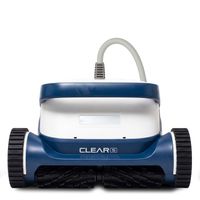
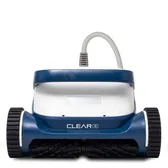
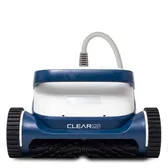
A 1-micron rating wins a silt job outright. Silt is defined by its smallness, and the Clear S fine panels are rated finer than the particles themselves, where a standard panel is not close. The second advantage is navigation: a gyroscope and accelerometer guide the route, and coverage tightens after 2 to 3 cycles, which fits a job that takes several cycles anyway. Ultra mode gives a 3-hour first pass, and Floor only keeps the robot down where silt lies.
The catch: with 8,500+ GPH moving through the robot, start it only once the silt has fully settled, and rinse the panels after every cycle at first.
Best for
Pools up to 50 ft hit by floodwater, runoff or dust storms, where silt is the main complaint.
Keep in mind
Frequent rinsing early on. It is an in-ground robot, priced above the Quantum.

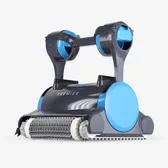
NanoFilters win the Premier second place, and the way it carries them matters. Its Multi-Media system includes three kinds of filter, so the same robot runs standard fine filters in ordinary weeks and NanoFilters when silt arrives, swapped through the top in seconds. A full-filter indicator on the power supply shows when the silt coat has cut the flow. The weekly timer then runs the follow-up cycles every day until the floor stays clean.
The catch: one cycle length, 3 hours, with no floor-only setting, so each pass spends time on walls that silt does not need.
Best for
Owners who want silt handled from the power supply, with leaf and everyday media in the same box.
Keep in mind
No short cycle. Each silt pass is a full 3 hours, then a rinse.
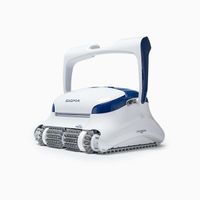
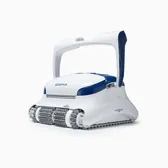
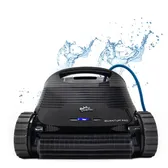
SmartNav 3.0 with an onboard gyroscope is the Sigma's winning spec for silt. Disturbed silt takes hours to settle again, so methodical, gyroscope-guided coverage is worth having. NanoFilters are included alongside standard cartridges, three commercial-grade ProLine motors supply 4,500 GPH, and the myDolphin Plus app warns you once silt has loaded the cartridges, then schedules the next run by day and time.
The catch: quad scrubbing brushes are built to scrub hard, and silt needs lifting more than scrubbing, so part of what you pay for sits idle on this job.
Best for
Owners who want gyroscope navigation, phone alerts and day-by-day scheduling in a pool up to 50 ft.
Keep in mind
Top of the price range. Rinse the cartridges until the water runs clear, or the next cycle starts half blocked.
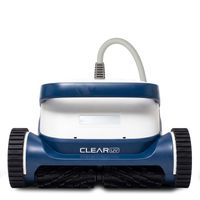
On silt, the Clear UV is the Clear S again: the same 1-micron fine panels, the same gyroscope and accelerometer, the same 3-hour Ultra pass and Floor only mode. If our first pick suits your pool, so does this one, and the 180-micron coarse panels are there for the leaves and twigs that floodwater brings with the silt. What you add is a UV-C light built into the robot and switched from the Clear app, at a price close to the Premier's.
The catch: the light plays no part in collecting silt. It ranks fourth because the Clear S does the identical silt job for less.
Best for
Buyers already set on the UV-C model who also need 1-micron filtration for sediment.
Keep in mind
Higher price than the Clear S with no gain on silt. Compare both live prices before deciding.
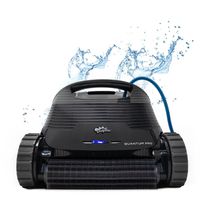
Over 400 square inches of filter area is the Quantum's answer to a debris that coats filters. Fit the full set of NanoFilter panels from the box and the XXL MaxBin spreads the silt over more surface, so the robot cleans more floor before flow drops. The top-load basket opens with a single click, and the 2-hour cycle is the shortest of the Dolphin picks here. Schedule repeat runs from the power-supply timer or the myDolphin Plus app.
The catch: 4,000 GPH is the least flow on this page.
Best for
Owners who want ultra-fine panels and a big basket at the lowest 50 ft price in this guide.
Keep in mind
A 2-year warranty, where the other four carry 3. Give the silt its full settling time.
Free Shipping30-Day Trial: use it in your pool, return it within 30 days of deliveryLow Price GuaranteeAuthorized dealer with the full manufacturer's warrantyInstallment options, when offered, appear at checkout
What Matters When the Problem Is Silt
-
How Fine the Filter Goes
This is the whole game. Silt particles are a small fraction of the size of sand grains, and only ultra-fine media stops them: the Clear robots' 1-micron panels, the NanoFilters in the Premier and Sigma, the Quantum's NanoFilter panel set. Anything coarser returns silt to the water.
-
Orderly Coverage
A robot that re-crosses its own track kicks up what it has not yet collected. Navigation that covers the floor once, in order, leaves less silt in suspension at the end of the cycle.
-
Filter Area
Silt coats a filter fast: a thin, even layer over the whole surface, then flow drops. A larger filter area buys more floor cleaned per rinse. Expect to rinse between cycles whatever you buy.
-
Easy Repeat Cycles
Nobody clears silt in one pass. Shorter cycle options, a timer or an app schedule make the second, third and fourth runs something the robot does while you do something else.
Silt-Ready Specs Side by Side
| Specification |
Clear S
Top pick
|
Dolphin Premier
Pick 2
|
Dolphin Sigma
Pick 3
|
Clear UV
Pick 4
|
Dolphin Quantum
Pick 5
|
|---|---|---|---|---|---|
| Price today | $1,749 | $1,949 | $2,349 | $1,999 | $1,599 |
| Filtration | UltraFilter basket: 1-micron fine and 180-micron coarse panels | Multi-Media: NanoFilters, oversized leaf bag and standard fine filters | NanoFilters and standard filter cartridges | UltraFilter basket: 1-micron fine and 180-micron coarse panels | XXL MaxBin basket with standard and NanoFilter panels |
| Filter access | — | Top-load, no tools | Cartridges | — | Top-load, one-click open |
| Brushes | Front and rear active brushes | Dual scrubbing brushes | Quad scrubbing brushes | Front and rear active brushes | Dual HyperBrush |
| Flow rate | 8,500+ GPH | 4,500 GPH | 4,500 GPH | 8,500+ GPH | 4,000 GPH |
| Cycle time | 1, 2 or 3 hours (six modes) | 3 hours | 2.5 hours | 1, 2 or 3 hours (six modes) | 2 hours |
| Cleans | Floor, walls and waterline | Floor, walls and waterline | Floor, walls and waterline | Floor, walls and waterline | Floor, walls, waterline, sun shelves and stairs |
| Scheduling | Weekly schedules in the Clear app | Weekly timer: every day, every 2 days or every 3 days | Weekly scheduler by day and time | Weekly schedules in the Clear app | Weekly timer: every day, every 2 days or every 3 days |
| Warranty | 3 years (limited) | 3 years | 3 years | 3 years (limited) | 2 years |
| Buy | See priceDetails | See priceDetails | See priceDetails | See priceDetails | See priceDetails |
Specifications are the manufacturers' published figures. Prices are live from our store.
The Settle-First Method
Silt in suspension cannot be vacuumed by anything, so the method is built around stillness.
- Pump off for several hours, overnight if the water is very cloudy. No swimming, no brushing, no water features.
- Lower the robot in gently and let it sink on its own. Dropping it in raises the cloud you just waited out.
- Run the first cycle with ultra-fine media and leave the pool alone until it ends.
- Rinse the filter until the water runs clear. A silted filter looks only slightly dirty and passes very little water.
- Run the pump for a few hours so the pool filter takes what is still floating, switch it off, let the pool stand, and repeat. Several cycles are normal after a flood or dust event.
When to Reach for Flocculant Instead
There is a point where a robot is the wrong first tool. If you cannot see the floor of the shallow end, or the layer is thick enough to hold a footprint, the faster route is chemical and manual. A flocculant binds the particles into heavy clumps that drop to the floor, and you vacuum them slowly to waste, sending the water out of the pool instead of through the filter. It costs water, and it needs a filter valve with a waste setting, but it removes in a day what would take a robot many cycles.
A clarifier is the milder cousin: it gathers fine particles so the pool filter can hold them. Follow the product label, take the robot out before you add either one, and bring it back afterward to finish the floor.
Pool Pro Tips for Silt
- Pool Pro tip: do the white-bucket test. Scoop pool water into a white bucket and let it stand for an hour. A tan film on the bottom means silt is still settling and the robot should wait.
- Pool Pro tip: keep a second set of ultra-fine filters if you can. Swap in the clean set, restart the robot, and rinse the silted set without holding up the cleanup.
- Find where the silt came from: a low spot in the deck, a downspout, a planter bed above the coping. Redirect the runoff or the next storm repeats the job.
Silt Questions Our Pool Pros Get
How do I tell silt from sand or dead algae?
Rub some between your fingers. Sand is gritty and falls straight back to the floor when stirred. Silt feels smooth, like wet flour, and hangs as a tan or brown cloud. Dead algae is gray-white to tan too, but it follows an algae treatment; silt follows rain, flooding or wind. The cleanup is similar for both: ultra-fine filtration with the pump off.
Why does the water cloud up when a robotic pool cleaner runs over silt?
Either the filter is too coarse or the silt had not settled. With standard panels a robot lifts silt off the floor and sends most of it back out, so the water clouds behind it. With ultra-fine media, clouding means the robot started too soon or the filter is so coated that flow has collapsed. Rinse it, wait longer with the pump off, and try again.
How long should the pump stay off before I run the robot?
Several hours at least; overnight is the safe answer after a flood or dust storm. Silt settles slowly, and the finest part of it slowest of all. If the floor has an even tan film and the water above looks clearer than it did, it is ready. If the water is still uniformly murky, waiting will do more than starting.
Will a Cayman or Escape pick up silt?
Not well as they come out of the box. Both ship with a MaxBin basket set up for leaves, grit and ordinary dirt, and silt passes through, so the robot mostly stirs it. NanoFilter panels are an optional add-on for both. If you already own one, buy the panels before you buy another robot.
The Pool Express Verdict on Silt
The decision rule is short: no ultra-fine media, no silt removal. Among robots that include it, take the Clear S for the finest rated panels, or the Premier if you want the same result from a power-supply timer with no app. The Sigma, Clear UV and Quantum all hold silt too; choose among them on navigation, the light, or price. For a pool you cannot see the bottom of, Ask a Pool Pro before you buy anything.
How we pick and how we earn: Pool Express is an authorized dealer and sells every robot recommended in this guide. Picks are ranked for this pool or problem from each robot's published specifications. Prices shown are pulled live from our store and may change. Last updated November 23, 2026.